Grandma and Her Legacy
Dr Anne Pia’s story of her grandmother Mariuccia Coletta is centred around her strong character and the values that she instilled in her family. Widowed after the loss of her husband on board the Arandora Star, she worked hard to establish herself as a successful business woman.
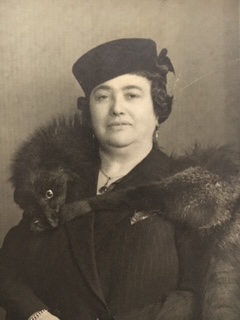
Mariuccia Coletta, Grandma, (1888-1964) was an elegant, refined, woman with a distinguished air, and a strong sense of self; she could be both charming and ferocious and she had a sharp sense of humour and a no-holds-barred laugh. In family she was direct and basic; and she combined this with white gloved car rides to Peebles Hydro each year, commanded the best table in Jenners tea lounge where she did in fact take tea; and won the charm and respect of the ennobled owner of Darlings in Princes Street where he would rush to find her a seat while she surveyed the best table linen or a pair of stockings.
Both furba (savvy)and in gamba (able), she had a strong sense of survival, a strong will to move up in the world, believing that was her destiny. Grandma arrived in Scotland in 1913 from the humble fields and harsh living conditions of Viticuso in the Lazio area of Italy. She had an ability to read both those she met with in business and in her personal dealings. She watched, learned, positioned and manoeuvred. She could neither read nor write but she spoke English well and she was a formidable business woman … an entrepreneur who respected and created entrepreneurs in her likeness.
In Shrubhill Café, the shop Grandma and my Grandfather owned during the war, Grandma stood sentry at the till ever resplendent in satin overalls and after the Arandora Star tragedy and the loss of my Grandfather, Grandma remained at the helm: her staff … Jimmy Gibson her chef in the back shop and Mrs Cairns serving tables. In the early 50s she bought the Copper Kettle Café and then an eye always on the social ladder, a flat for herself, my mother and me, in the well-doing area of Bruntsfield where she became a well-respected member of the neighbourhood.
Grandma commanded attention wherever she went. No sense of underdog or inferiority there or indeed within the family, indeed the opposite; but a skillful and wise blending into post-war Scottish life for herself and her children. Not easily achieved: “mettete co chi è meglie re te e faglie la spes” (mix with your “betters’ and learn from them). And again “fatte rispetta”… (make them respect you) but done with guile, charm, watchful assessment and skill.
In the mid-1950s Grandma had a stroke and retired from café life, handing the running of the café to my mother Cristina, who by that time was separated from her Scottish husband. Consequently, I grew up in Grandma’s care until my early teens and even shared her bed for many of those years. I well remember our conversations through the night. I was often asthmatic or anxious and Grandma, rosary always in hand and on her lips, would soothe me with tales of her past in Viticuso and share her philosophies and reflections … earning respect, working hard to get to the top … achieving … the importance of education as a means to success: “If I could read and write” she’d say, “I would have been a lawyer”. I was doing well in those difficult first years at school and she was proud of me.
Family was important to her of course but family life had to fit around the demands of business when there was money to be made. Figura was also important to her as it probably is to most Italians. But Grandma saw it as symbolic of stature, rank and breeding. She would always dress to impress: often gloriously hatted, fine leather gloves and calf leather shoes that showed off her still slim ankles. On special occasions, she was triumphant in fox furs.
Ours was an unusual Italian home. While Grandma had blazed the trail in relation to ‘settling’ and acceptance finally, my mother’s generation firmly rooted their children and grandchildren in an appreciation and passion for the Arts … certainly a social marker too. Edoardo Paolozzi was a first cousin, his father Pietro was my Grandfather’s brother. Art then, drawing, painting, architecture were both an interest and focus of discussion in the wider Rossi family and a surprising skill. Rico my uncle, painted in retirement; my cousin Eric gained entry to the Edinburgh College of Art to study architecture; and his daughter Stephanie a retired veterinary surgeon in Australia is an acclaimed artist and exhibits regularly. From a very early age I had heard of the glories of the Sistine Chapel, Caravaggio’s chiaroscuro, and “Titian red”. That generation also shared a love of the American and Soul music of the time Billie Holliday, Louis Armstrong, Tommy Dorsey, Fats Waller, Crosby, Sinatra; and not to mention books. My mother, herself, read avidly and her book choices were a firm foundation for my life-long love of languages and literature. There was no “being put behind the counter” for me “to learn the meaning of money”. From an early age I had a library card and was encouraged to read and to potter about on a piano, bought earlier by Grandma – to display “class” and “breeding” I imagine.
Finally, to complete this fine legacy from Grandma in a way, the finest gifts of all – the glorious Laziale dialect which I learned literally at her knee. Grandma also had a firm belief that good health comes from good fresh produce which was hard to find in the years after the war. But she bought her chickens from farms outside Edinburgh, ordered whitebait ahead and when available from her fishmonger; grew what herbs she could, made her own ricotta, chips hand-cut and cooked in olive oil; and fed her family with love and carefully sourced fare, laboured over with pride. And if you happened to drop in around 11pm any night, a twelve-egg frittata was no trouble at all.
Despite many difficulties within the family … those restrictions, oppressions; the old order and community norms unquestioned and unchallenged, that I sought to escape from, I have finally been able to enjoy those freedoms that ultimately Grandma and my mother as independent and free-spirited women, under no rule or thumb and indomitable, wanted me to have.
I consider myself hugely fortunate.
They broke the mould. We, my children and I, followed.
Dr. Anne Pia
Back to Long Reads