Widowhood
The histories of Italian migration and scientific instrument making in Scotland have often been interpreted through the activities and contributions of men, yet surviving records reveal women who participated in these family enterprises. Widowhood could create opportunities for women to assume more visible roles, as the cases of Ann Galletti in Glasgow and Isabella Lovi in Edinburgh suggest.
Despite legal, educational, and professional constraints, women in nineteenth-century Scotland participated in economic life in ways that often blurred the boundaries between household and workplace (Breitenbach et al). Class shaped the nature of this participation. Working-class women were commonly engaged in paid labour throughout their lives, often with limited access to formal education, while middle- and upper-class women could more easily participate in business activities and were more likely to benefit from private tuition (Breitenbach et al, 2013; Morrison and Falconer, 2022). Within artisanal households, women’s labour could encompass domestic responsibilities, commercial activities, and forms of practical knowledge associated with family trades. Widowhood could make these existing contributions more visible, bringing women into positions of ownership, management, or public recognition.
The family businesses discussed here formed part of a longer history of Italian migration to Britain, dating back to the eighteenth century, when economic migrants, many of them skilled artisans, merchants and craftsmen, settled in urban centres such as Manchester, Bristol, Edinburgh and Glasgow. Among the crafts they practised were glassblowing, carving and gilding. The production of barometers, thermometers, mirrors, and optical and surgical instruments formed part of the work undertaken by these artisans, who described themselves as philosophical, mathematical or scientific instrument makers. These objects functioned both as practical tools and as markers of status within middle-class households (Morrison-Low, 2016).
This trade developed within a socioeconomic landscape profoundly shaped by industrialisation and imperial expansion. Economic growth, urbanisation, and the accumulation of wealth generated through empire and technological change fuelled demand for scientific instruments (Morrison-Low, 2016). At the same time, the devastation wrought by the Irish Famine prompted large-scale migration to Scotland, reshaping the country’s demographic composition and contributing to sectarian tensions and anti-Irish prejudice. It was within this changing social and economic environment that Italian migrants settled, established businesses, and negotiated their place in Scottish society.
The manufacture of scientific instruments was often dependent on expertise in glassblowing. This was delicate work, performed over a flame as molten glass was stretched, blown, and sealed into the desired form. Glassworkers typically laboured near intense heat, repeating the same movements for prolonged periods. The craft depended upon tacit forms of knowledge acquired through practice, including an understanding of the behaviour of glass under heat, thermal expansion and contraction, and the properties of alcohol and mercury in relation to density and buoyancy.
Ann Galletti and Isabella Lovi both married Italian craftsmen and, after widowhood, continued their husbands’ businesses. In doing so, they likely drew upon practical knowledge acquired through years of participation in family workshops, including familiarity with the manufacture and sale of scientific instruments and, in Lovi’s case especially, the skilled glasswork on which such production depended. They were wives, mothers, and widows, but also businesswomen, artisans, and innovators.
‘Mrs Galletti’
Ann Galletti (née Bucknall) was born around 1791 in Corbridge, England. In 1819, at St Mary’s Cathedral in Edinburgh, she married Anthony (Antoni) Galletti, an Italian migrant from Milan who was approximately twenty years her senior.

Image 1 – Ann Bucknall and Anthony Galletti parish marriage record 1819
© Catholic National Endowment Trust Charity No. SCO 16650 (known as The Bishops’ Conference of Scotland
Antoni was on the board of directors for the Glasgow Catholic School, an organization founded in 1817 to establish the city’s first structured Catholic education system during a period of rapid Irish immigration. In their own home, too, the effects of Irish immigration and the potato famine are evident. The Galletti household is recorded as employing four female servants between 1841 and 1851, all of whom were Irish and as young as 10 or 11 years old. In 1827 Ann’s name appears among the communicants and converts recorded at St Andrew’s Cathedral, suggesting that she adopted her husband’s Catholic faith.
By the time of their marriage, Antoni had already established himself as a maker and retailer of scientific instruments, having operated his business since 1795. He manufactured and sold barometers, thermometers, telescopes, looking glasses and other optical instruments, while also practising as an optician. The family occupied a shop in Glasgow’s Argyle Arcade, a prestigious commercial address in the city centre long associated, as it remains today, with luxury retail, jewellery and specialist craftsmanship. Although the business was advertised exclusively under Anthony’s name, Ann worked alongside him in the shop. Her contribution, however, remained largely invisible in the documentary record: in the 1841 census she appears simply as “Mrs Galletti”, with no occupation recorded, reflecting the tendency of census categories to subsume married women’s work under their husband’s occupation or identity.

Image 2 – Ann Galletti advertises she will continue the family business after Anthony’s death
© Glasgow Herald, 06 January 1845
When Antoni died in 1844 at the age of seventy, Ann assumed responsibility for the business. In a newspaper notice announcing his death, she stated that she “continues the Business as formerly”, indicating that she had already been actively engaged in its day-to-day operation before becoming its public proprietor. The shop continued to be listed as A. Galletti, and in the 1851 census – seven years after Anthony’s death – she was recorded, not as Mrs Galletti but “A Galletti”, widow and optical instrument maker.
The couple had five children. Only a year after Anthony’s death, Ann suffered another bereavement when her daughter Mary Ann died at the age of nineteen. In 1870, at the age of 79, Ann died, leaving her son John to continue the business until his death in 1894. The shop was then sold, bringing to an end almost a century of trading under the Galletti family.

Image 3 – Telescope manufactured by John Galletti
© National Museums Scotland (Records of the Scottish Cultural Resources Access Network (SCRAN), Edinburgh, Scotland)

Image 4 – Obituary of Ann Margaret Bucknall from Catholic Directory 1871 – 1875
© Catholic National Endowment Trust Charity No. SCO 16650 (known as The Bishops’ Conference of Scotland)
‘Mrs Glassblower’
Isabella Lovi was a maker of scientific instruments living in Edinburgh in the late eighteenth and early nineteenth centuries. She married Angelo Lovi of Milan, who had settled in Edinburgh in the late eighteenth century, where he established a business based on his expertise in traditional glassblowing.
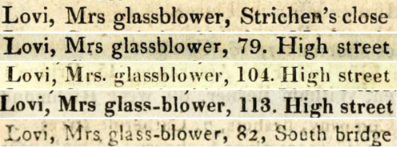
Image 5 – Post office directory entries for Isabella Lovi, ‘Mrs Glassblower’, at multiple Edinburgh addresses
© Post Office Directories, Previously Hosted on Mocavo.com
In 1805, following the death of Angelo, Isabella inherited the business from her husband, continuing its manufacturing and commercial operations under her own management. Before his death, Angelo had attempted to sue for defamation after being accused in 1802 of having another wife, a dispute that briefly brought the family’s private life into public legal record.
Following his death, Isabella appears in records at various addresses and under shifting descriptions, including glassblower and Mrs glassblower, and later, as artificer in glass and chemical apparatus maker (Higgitt, 2026), reflecting an evolving public identity as a skilled maker in her own right.
Lovi became known for her work on gravity beads – small glass spheres used to estimate the relative density of liquids, including alcoholic spirits, and to test fat content in milk. Her development significantly expanded the scale of the instrument, increasing the range to more than 350 beads, compared with the more typical sets of around 10 to 30, and thereby enabling a far broader spectrum of measurements (Higgitt, 2026). The 1805 patent for the invention was registered jointly with John Robert Irving, a lawyer and member of the Highland and Agricultural Society, which also awarded Lovi five guineas for her method of testing milk density. Rebekah Higgitt (2026) suggests that Irving may have assisted with the patent process, given the barriers faced by women in securing formal recognition at the time, although the improvement is still attributed to Lovi.

Image 6 – Gravity beads made by Isabella Lovi in Edinburgh, c.1810.
© National Museums Scotland (Records of the Scottish Cultural Resources Access Network (SCRAN), Edinburgh, Scotland)
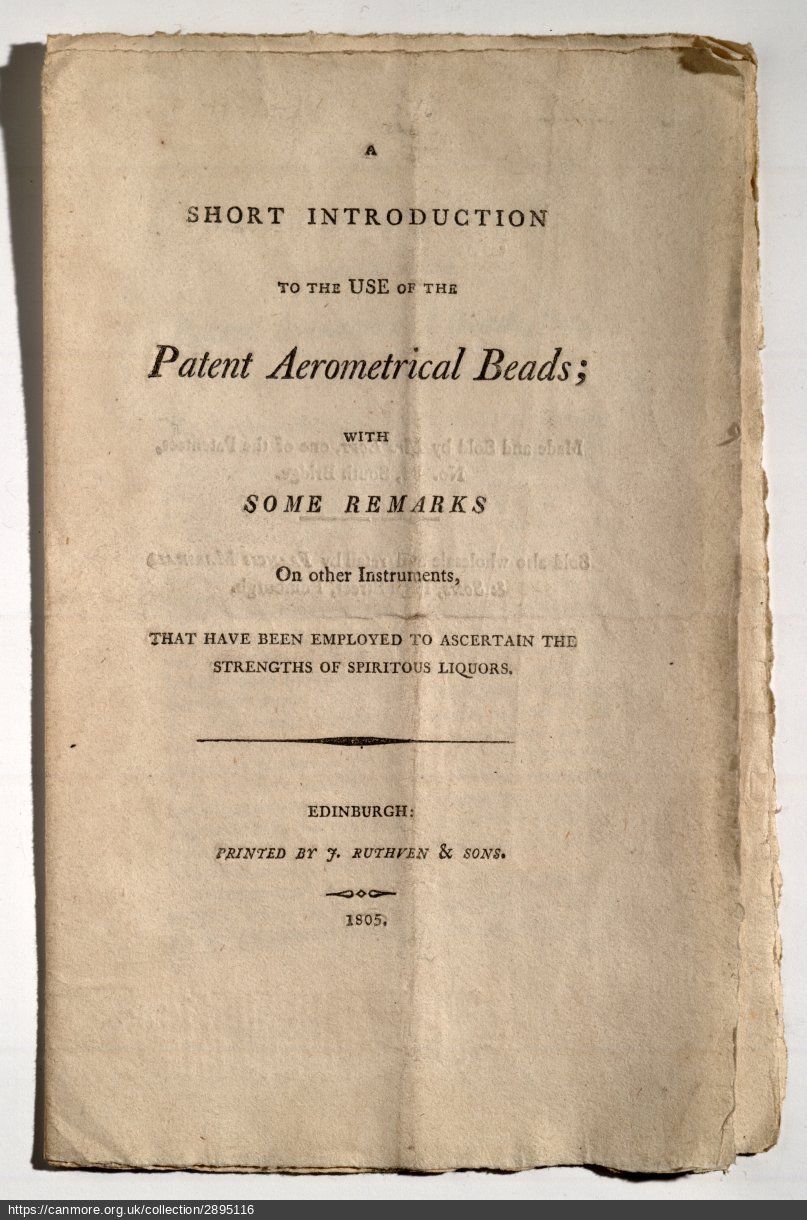
Image 7 – Instruction book for Isabella Lovi’s patent aerometrical beads, 1805.
© Licensed by National Museums Scotland (Records of the Scottish Cultural Resources Access Network (SCRAN), Edinburgh, Scotland).
Lovi’s work as a glassmaker, instrument maker, and innovator points to a high degree of technical skill and practical scientific knowledge at a time when women had limited access to formal scientific education. She may have first encountered the trade through her husband, yet it was her refinement of the gravity beads that brought her lasting acknowledgement. She died in 1826, having overseen the enterprise for a further twenty-one years and establishing a reputation for technical expertise that was uncommon for women of her time.
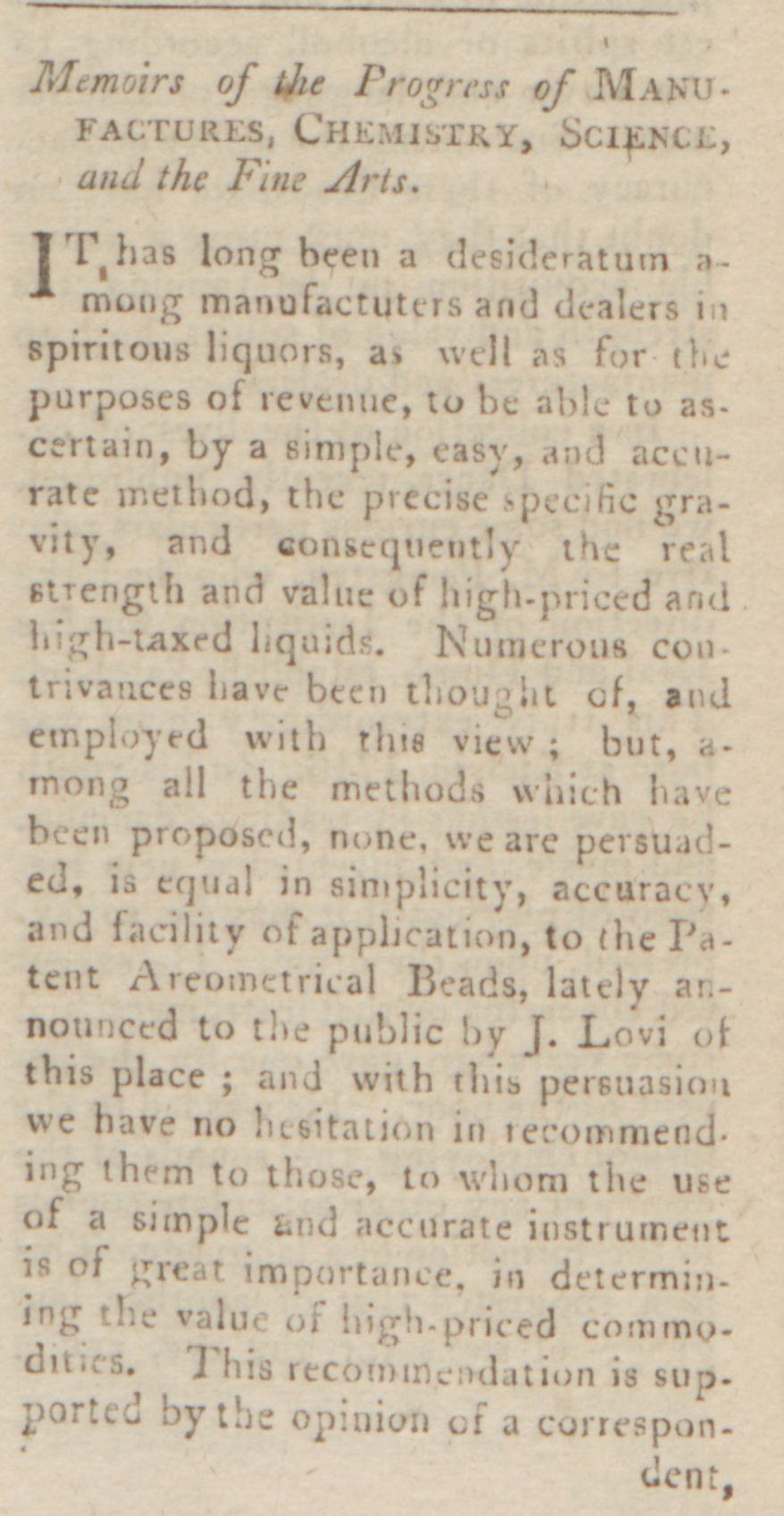
Image 8 – Published endorsement of Isabella Lovi’s patent aerometrical beads from 1807
© The Scots Magazine, 01 October 1807
Sources:
Breitenbach, Esther, Linda Fleming, S. Karly Kehoe, and Lesley Orr. “Introduction.” Scottish Women: A Documentary History, 1780–1914, edited by Esther Breitenbach, Linda Fleming, S. Karly Kehoe, and Lesley Orr, Edinburgh University Press, 2013, pp. 1–39.
Clarke, T. N., Alison D. Morrison-Low, and A. D. C. Simpson. Brass & Glass: Scientific Instrument Making Workshops in Scotland as Illustrated by Instruments from the Arthur Frank Collection at the Royal Museum of Scotland. National Museums of Scotland, 1989.
Higgitt, Rebekah. “Mrs Lovi’s Beads.” teleskopos, 2 Mar. 2026, https://teleskopos.wordpress.com/2026/03/02/mrs-lovis-beads/.
Morrison-Low, A. D. Making Scientific Instruments in the Industrial Revolution. Routledge, 2016.
Morrison, Amie, and Isobel Falconer. “Women’s Participation in Mathematics in Scotland, 1730–1850.” British Journal for the History of Mathematics, vol. 37, no. 1, 2022, pp. 2–23. Taylor & Francis, https://doi.org/10.1080/26375451.2022.2053370.
Back to Long Reads